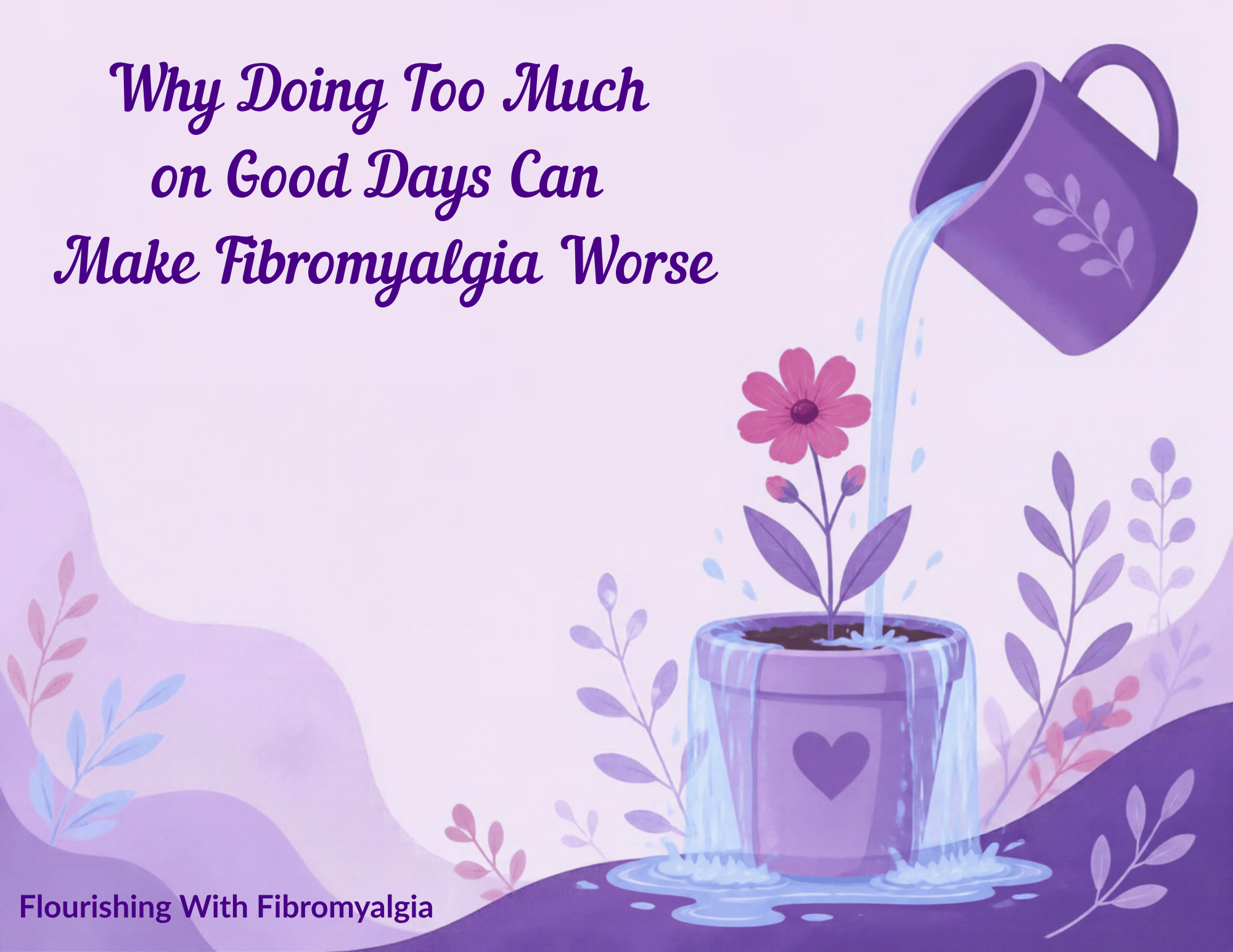
You woke up and something felt different, lighter almost. The pain was quieter, your head felt clearer, and for the first time in a while, you actually felt like yourself. So you did what felt natural: you made the most of it. Groceries, that overdue phone call, maybe a walk with the dog you've been meaning to take. By evening you were tired, sure, but it felt like the good kind of tired. Then the next day arrived, and it hit you like a truck.
If you've lived this exact sequence more times than you'd like to admit, you're not alone, and you're definitely not doing anything unusual. In fact, this is one of the most common patterns I hear about, and understanding why doing more on a good day backfires is a genuinely important piece of managing fibromyalgia well.
In my last post, we talked about thinking of your energy like a bank account, and how overspending on good days keeps you stuck in what's often called the boom and bust cycle. I want to go a layer deeper here, into why exactly this happens physiologically, because I think understanding the mechanism makes it much easier to actually change the pattern.
When you push past your body's current capacity, even on a day that feels genuinely good, a few things happen internally. Overexertion triggers a spike in cortisol, your stress hormone. Remember that cortisol and melatonin, your sleep hormone, exist in a delicate balance, so when cortisol spikes from overdoing it, melatonin release later that night gets disrupted too. This is why you can feel utterly wiped out after a busy day and still not sleep well that night, a pattern often described as "tired but wired."
There's also a mitochondrial piece to this story. Your mitochondria are the parts of your cells responsible for producing usable energy, and in fibromyalgia, they don't tend to replenish that energy as efficiently as we'd expect. When you push hard on a good day, you're asking those already strained mitochondria to work overtime, and the resulting energy debt doesn't just disappear, it tends to show up as amplified fatigue, pain, and brain fog over the following days.
Put simply, your body doesn't experience a good day as evidence that you're "fixed" or that your normal limits no longer apply. It experiences a busy day exactly the way it always would, it just may not send you the bill immediately.
I want to name something honestly, because I think it deserves compassion rather than correction. Almost everyone I've worked with describes some version of the same inner monologue on a good day: I have to get this done while I can, who knows when I'll feel this way again. That instinct makes complete sense. You've likely missed out on things, fallen behind on tasks, or disappointed yourself and others during flares, and a good day can feel like your one shot to catch up.
But this is precisely the trap that fuels the crash cycle. Treating good days as catch-up days, rather than as an opportunity to gently build your baseline over time, tends to keep you oscillating between overexertion and collapse, without ever making steady forward progress. It can take days, sometimes weeks, to recover from a genuine crash, which often costs you far more functional time than the single productive day gained you.
One thing many people find helpful is simply keeping track. Jotting down what you're doing throughout the day, along with a quick note on how your energy and body are feeling, can be a low-pressure way to see what's really going on. It doesn't need to be fancy. A notebook or a notes app is plenty.
Over time, patterns can jump out that are hard to notice otherwise. You might find that an errand you assumed was easy takes more out of you than expected, or that mornings tend to be your strongest window while afternoons fade. You might notice that a "good" day left you more drained than it looked at the time. Having real observations about your own body may take some of the guesswork out of planning your days.
A word of caution though: some people find tracking a little difficult emotionally at first, especially if it shows just how little it takes to use up their energy for the day. That reaction is completely normal, and it's okay to keep it light. Many people find that having something written down helps them see their progress over time, rather than relying on memory alone.
You can explore a more structured, step-by-step version of this kind of pattern reading further inside the Flourishing With Fibromyalgia Academy.
Spread big tasks across several days instead of one.
If a big task tends to leave you flaring, consider splitting it into smaller pieces over several days instead of one big push. Prepping for a family get-together, for example, doesn't have to happen all at once. The job still gets done, but no single day has to carry the whole load.
Build rest into good days too, not just bad ones. It can feel unnecessary to rest when you're feeling well, but scheduled breaks before you feel like you need them help prevent you from unknowingly overdoing it without realizing.
Notice what drains you and what restores you. Notice which people, activities, or environments consistently leave you more depleted, and which ones genuinely restore you. This awareness helps you make more intentional choices about where a good day's energy actually goes.
Practice a pause before saying yes. When an invitation or opportunity comes up on a good day, try responding with "let me check and get back to you" rather than an automatic yes. That small pause gives you room to consider your recent activity level rather than deciding purely on how you feel in that exact moment.
Ask yourself if an activity is serving you. Some things we do purely out of habit, not because they truly matter to us. On a good day, it's worth asking whether a planned activity is something you genuinely want to spend your limited energy on, or something you're doing simply because you always have.
As always, if you notice a significant or unexplained change in your energy patterns, or if crashes are severe, prolonged, or worsening despite consistent pacing, please bring this to your doctor, since it's worth ruling out other contributing factors alongside the strategies discussed here.
A good day isn't a loophole in your fibromyalgia, and it isn't proof that your limits have disappeared. It's an opportunity to gently build momentum, if you protect it rather than spend that energy all at once. Understanding the very real, very physical reasons behind the crash cycle is the first step toward finally breaking it.
This exact pattern, along with practical tools for pacing and energy tracking, is something you can explore in detail inside the Flourishing With Fibromyalgia Academy. If you're ready to stop losing good days to the crashes that follow them, I'd love to have you join us there, starting with a 7 day free trial.
Try the Flourishing With Fibromyalgia Academy free for 7 days and see how it feels to plan your days around your energy, not in spite of it.